“Responsibility isn’t something we carry. It’s something that sets us free.”
Last month, Chad invited us into one of the most important practices of conscious leadership in his blog, The Strength of Structure: Staying Present With What Is. He reminded us that growth doesn’t come from rushing past discomfort. It comes from slowing down long enough to see clearly because clarity always comes before meaningful action.
As I reflected on his words, another question kept returning to me. Once we see reality clearly… What do we do next? For many of us, this is where growth quietly pauses. Not because we don’t care. Not because we lack integrity. Because we’re human.
We recognize the conversation we avoided. The decision that didn’t create the outcome we hoped for. The relationship that feels strained. The pattern that keeps repeating. Instead of moving toward ownership, we often move toward explanation. We defend our intentions. We justify our choices. We tell ourselves stories that make the outcome easier to live with.
I’ve done it. I’m guessing you have too. Not because we’re trying to escape responsibility, but because somewhere along the way many of us learned that making a mistake meant being a mistake. What if that simply isn’t true?
Returning Home Instead of Defending Ourselves
One of the greatest lessons I’ve been learning is that conscious leadership isn’t about becoming someone different. It’s about remembering who we are beneath fear. Before we learned to protect our image. Before perfection became our measure of worth. Before being right felt safer than being honest.
The moment we stop protecting our identity, we become available for growth. That simple shift changes everything. Ownership no longer feels like punishment. It feels like freedom. Freedom to stop defending, to stop performing, and to simply tell the truth. Not because the truth is always comfortable, but because it is always where growth begins.
As Carol Dweck reminds us,
“Becoming is better than being.”
Leadership isn’t a destination we arrive at. It’s a lifelong practice of becoming. Every challenge offers another opportunity to grow, if we’re willing to learn instead of defend.
Responsibility Frees Energy
One of the themes we’ve been exploring this month is simple: Responsibility frees energy. Blame keeps us looking backward. Ownership creates movement.
Blame asks:
- Who was wrong?
- Who should have known better?
- Whose fault was it?
Ownership asks something much more freeing:
- What happened?
- What is this experience trying to teach me?
- What would ownership make possible here?
Those questions create momentum.
I’ve come to believe that responsibility doesn’t add weight. It removes it. Because once we stop carrying shame, we have both hands free to build something new: healthier relationships, stronger teams, and honest conversations. Organizations where learning becomes part of the culture instead of something we avoid.
The Yin and Yang of Accountability
For a long time, I believed compassion and accountability lived on opposite sides of leadership: One felt soft, while the other felt strong.
Today I see them differently. They were never meant to compete. They complete one another.
The Yin of Ownership
- Compassion
- Self-forgiveness
- Humility
- Reflection
- Psychological safety
- Emotional responsibility
The Yang of Ownership
- Clear ownership
- Follow-through
- Repair
- Healthy standards
- Continuous improvement
Compassion without accountability creates comfort. Accountability without compassion creates fear. And healthy leadership requires both.
Compassion creates the safety people need to tell the truth. Accountability creates the clarity that helps them grow from it.
Amy Edmondson, whose work on psychological safety has transformed leadership around the world, says it beautifully:
“The goal is not to avoid failure. The goal is to fail intelligently.”
When people feel psychologically safe, mistakes become conversations instead of character judgments. That’s where wisdom is born.
The Stories Beneath Our Behavior
One of the reasons I love working with Human Design, the Enneagram, and the Conscious Leadership Compass™ is that each of them points toward the same truth from a different direction.
- Human Design helps us understand how our energy naturally moves through the world.
- The Enneagram gently reveals the protective patterns we developed to feel safe, accepted, or enough.
- The Conscious Leadership Compass™ invites us to return to the values that remain steady when fear is no longer leading the conversation.
Different maps. The same invitation. Awareness before action.
Because once we begin to notice the stories beneath our behavior, everything changes.
Instead of asking, “Who’s to blame,” we begin asking, “What part of me feels threatened right now?”
Awareness creates compassion. Compassion makes ownership possible. Ownership creates freedom.
Where Are We Protecting Egos Instead of Results?
This question has quietly become one of my favorites. Not because it points fingers, but because it opens doors.
- Where are we explaining instead of listening?
- Where are we avoiding honest feedback because we fear being wrong?
- What am I defending that could instead become a lesson?
- Where have I confused accountability with criticism?
- What responsibility have I quietly handed to someone else?
- What conversation begins once blame ends?
These aren’t questions meant to create guilt. They’re invitations to become more aware.
Brené Brown writes,
“Accountability is not a consequence. It’s a gift.”
I couldn’t agree more. Accountability restores trust. It reminds us that learning requires honesty. That mistakes become wisdom when we’re willing to examine them with curiosity instead of shame.
Roots Create Freedom
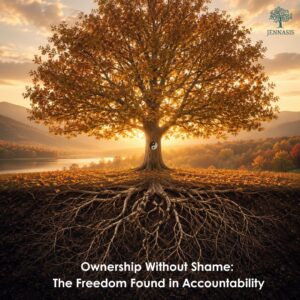
One of my favorite images this month comes from nature. Trees don’t grow taller because they reach harder. They grow because their roots deepen. Ownership works the same way. Every honest conversation deepens the roots. Every repaired relationship strengthens them. Every lesson embraced instead of defended expands them.
The deeper our willingness to own reality…the more freedom we have to grow. Not because life becomes easier, but because we’ve become more grounded.
Leadership That Liberates
Simon Sinek reminds us,
“Leadership is not about being in charge. It is about taking care of those in your charge.”
That care begins with how we model ownership. The strongest leaders I know aren’t the ones who always have the right answers. They’re the ones willing to say,
- “I missed that.”
- “Help me understand.”
- “Let’s repair this together.”
They create cultures where mistakes become learning instead of identity. Where blame is replaced with curiosity. Where people move forward instead of getting stuck defending themselves. Ownership isn’t about carrying the weight of every mistake. It’s about carrying the wisdom that comes from them.
When leaders replace blame with curiosity, trust grows. When teams replace defensiveness with learning, clarity emerges. When organizations replace shame with ownership, momentum becomes sustainable.
Perhaps that’s the invitation this month. Not to become more perfect. Not to become more critical. Simply to become more available for growth. Because mature leadership isn’t measured by never getting it right. It’s measured by what we choose to do next. And maybe that’s what conscious leadership has been inviting us toward all along. Not becoming someone new. Simply returning home to who we were created to be.